Information products play a pivotal role in the fast-paced digital world. They help build a brand, generate passive income, and establish authority in any business niche. Whether you're a coach, entrepreneur, consultant, or creator, information products can open doors to magical opportunities, new audiences, and steady revenue streams.
The internet is filled with many courses, ebooks, memberships, and workshops that help you create an information product. However, they aren’t enough because you need to design something that your audience actually wants. That is the idea they are willing to pay for.
Our comprehensive blog will help you turn an idea into a profitable information product. Discover how to validate your concept, create high-quality content quickly, become an expert problem solver through your products, avoid the most common mistakes that kill sales, and choose the best type of information product for your goals.
Turn your expertise into income and make your mark with powerful information products!
Does Your Audience Need It? Tips on Ensuring Your Information Product Will Sell
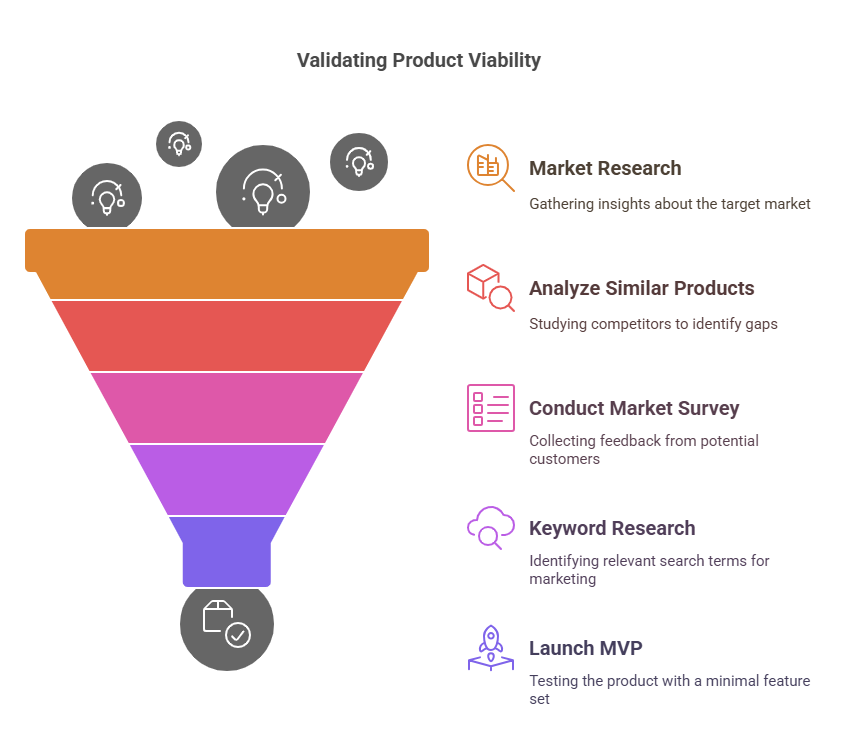
A crucial step in creating an information product is to make sure that it will sell. Information products are easy to produce with very low overhead, but it doesn't make sense to put forth the effort without a guaranteed return. You can never be 100% sure, but here are some ways you can make an educated guess.
Conduct Market Research
Use the Internet to conduct market research. There are plenty of opportunities online to get a thorough understanding of your market. Try to get a sense of the overall size of your market. An easy way to do this is to identify a key demographic and then make an estimate according to population.
For example, your target market may be men in the 40-55 age range in mid-sized cities in the American Midwest. There are plenty of census and demographic resources online where you can find this data. You can further refine your search by adding other key demographics. You'll end up with an idea of how many potential buyers there are.
Look at Similar Products
You can research similar products online. Try to determine whether these products are selling or not. Good resources for doing this include ClickBank and Amazon. You can't get specific data on volume sold on these sites, but you can get an idea by looking at the reviews.
Simply searching for similar products and browsing can glean quite a bit of information. In addition to finding reviews, you might see mentions in forums or on social media. You can get an idea of popularity by looking at how much a product is talked about, as well as a general idea of how people feel about it. For example, you might come across a social media comment where a buyer is saying they wish the product had gone into more detail on a specific topic, and you can then cover this topic by using psychological trigger hooks to better meet customer needs.
Conduct a Market Survey
Before the treasure trove of market information that is the Internet, businesses conducted market surveys. This, too, is made easier by the Internet. You can conduct surveys online with current customers, your target market, or social media followers.
Ask specific questions about what types of products they'd like to see, as well as problems they’re facing. The insights you gather will help you create your ideal customer profile, giving you a clearer understanding of who you’re selling to. If you can address and solve a problem, you're virtually assured sales.
Keyword Research
You can use a tool like Google’s Keyword Planner Tool to research search terms and discover search volume. Pick a few keywords that describe your product and do a search. Are people searching for this keyword?
Google Trends is another good research tool. It shows you which keywords are trending and their search volume over time in graph form. You might discover that your chosen keywords are on an upward trend, which means there's rising demand.
Launch a Minimum Viable Product
Before you launch the full product, you can create a minimum viable product (MVP) and see how it performs. Take one problem and solve it, or one topic from your bigger product. If your MVP sells well or draws a great deal of interest, you know that you're ready for the full product.
4 Keys to Fast Information Product Creation
The best information product strategy is to produce and publish continuously. Try to flood the market with products that solve your target audience's problems and show off your expertise. Following a solid product launch strategy for each release ensures you maximize visibility and impact. With a great number of products on the market, you have more opportunities to be seen by the people who could use your help and become your customers.
That all sounds great, but there's one big challenge.
Who has the time to keep pumping out high-value information products? The challenge here is two-fold: you need high quantity and high quality.
Here are four keys to creating information products quickly and in high volume without skimping on quality.
Create and Implement a System
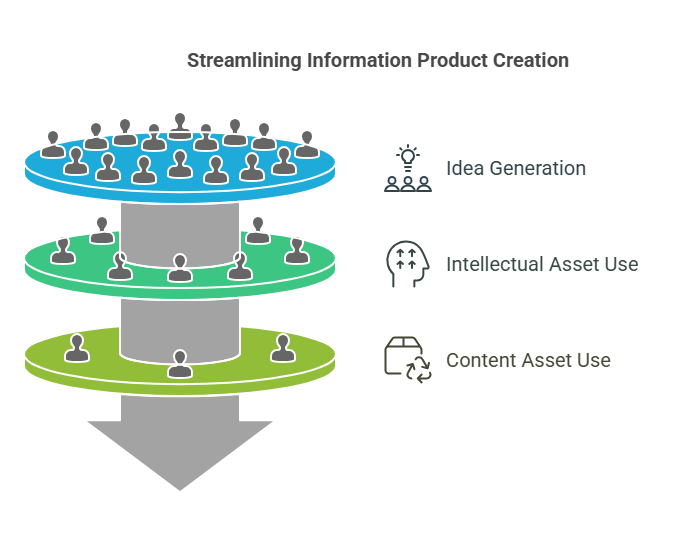
Create a streamlined system for information product creation. With a solid system in place, you can then simply plug in your ideas, gather and create your content, and then publish your latest product so that it's ready to buy.
This requires a bit of planning. You need to research and identify a target market profile so you know exactly for whom you're writing. You need to gather the resources and tools you need so that they're at hand when you need them. Use outlines, checklists, and templates for making the actual content creation smooth and easy.
Finally, tweak your system as you go along and discover areas where you can further streamline.
Ideas Coming Down the Pipeline
One of the challenges businesses face with infoproduct creation is coming up with ideas. To speed up the process, create an idea pipeline. Become an obsessive collector of ideas and compiler of lists. Listen to feedback from your market and the latest news in your industry for new ideas.
Once you have a list of ideas, prioritize. Start with the top item and keep adding as new ideas emerge. Managing this process efficiently is key, because profit is essential for business success, and having a steady flow of strong product ideas keeps your business moving forward.
Leverage Your Intellectual Assets
Your "intellectual assets" are the things you know that your audience doesn't. What can you teach others? These are the types of things that people constantly ask you about, and these are the areas where you have knowledge, experience, and skills.
You probably already have a good idea of what these natural strengths are, but by identifying and clarifying them, you can create products that really play to your strengths and offer a unique solution to your audience.
Leverage Your Content Assets
A great way to speed up the product creation process is to leverage the content you create or already have. You can take old content and repurpose or update it to create new value for your market. You can also create new content with repurposing in mind, cutting down on labor. Turn videos into blog posts, audio files into slideshows, long articles into infographics, and so on.
Fast info product creation offers a number of advantages. The key is to make sure that each product you put out there offers some unique value to your market. Speeding up the process ensures that you can meet your audience's needs without cutting corners on quality.
Become an Expert Problem Solver Through Information Product Creation
The best way to ensure continued sales and long-term customer retention is to frame yourself as an expert. When people need information or tips on how to do something, they always turn to an expert they follow. You can become that expert by sharing what you know with your audience, focusing on their problems, and learning how to sell smarter with a sales funnel. And this isn’t hard to do at all.
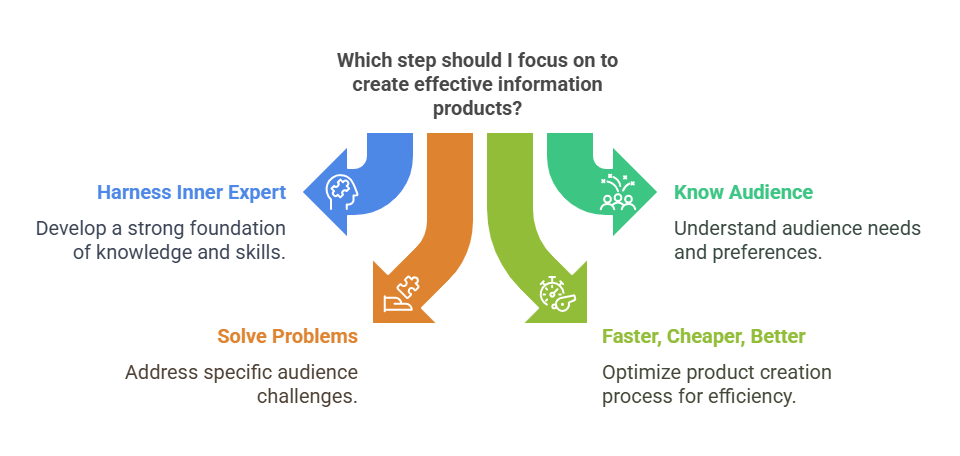
Harness Your Inner Expert
Whether you realize it or not, you are already an expert. If you're running any kind of business, you know how to do things that your audience doesn't. You've spent the last X number of years immersed in whatever it is you do, while your audience members have been immersed in whatever they do. So, the key is to get in touch with your inner expert.
Ask yourself:
- What do you know that your audience doesn't?
- What are you good at?
- What do people often ask you about?
- What are your natural strengths?
- What things have you spent the last few years building up experience in?
You just need to match this natural expertise with the problems of your audience and then offer a solution using what you know.
Get to Know Your Audience
The better you know your audience, the better you'll understand their needs. When you match your products perfectly to your customer's needs, they'll think you have ESP. Just at the moment when they're struggling with their current problem or hurdle, you put out a product that walks them through an easy solution. One of the best ways to achieve this is to personalize your marketing efforts with customer segmentation, making sure the right solutions reach the right people at the right time.
Solve Your Audience's Problems
Not all information products target specific problems. Some are purely informational. But if you can focus on a problem and solve it, you're assured sales and a strong following. Answer your customers' problems, relieve their pain, or teach them how to do whatever it is they need to do to get unstuck wherever they are.
Faster, Cheaper, Better
There is a good chance that someone else out there is already helping your customers with this problem. In fact, it's a certainty, and it's also likely that this is a big company with bigger resources than you have at hand. So, you can stand out within your market by offering a unique solution to the problem.
The best way to be unique is to help your audience do something faster, cheaper, and/or more efficiently. Everyone wants to save money. Everyone wants to make a problem disappear ASAP. Everyone is looking for a better way to do what they need to do.
Rapid Fire Product Creation
The best strategy for information product creation is to produce a large number of small, tightly focused products rather than trying to create the be-all and end-all product for your topic. When you produce small products that each focus on and solve one single problem, you spread your expertise far and wide and create more opportunities for people to see and benefit from it.
3 Deadly Info Product Creation Mistakes to Avoid
Creating and publishing information products is a great way to earn profits, establish yourself as an expert in your niche, and build a relationship with your audience. It's very easy to do. All you need is a streamlined system, like an Entrepreneurial Operating System, for producing high-quality info products efficiently and quickly.
Although it's straightforward, there are a few common pitfalls that many business owners fall victim to.
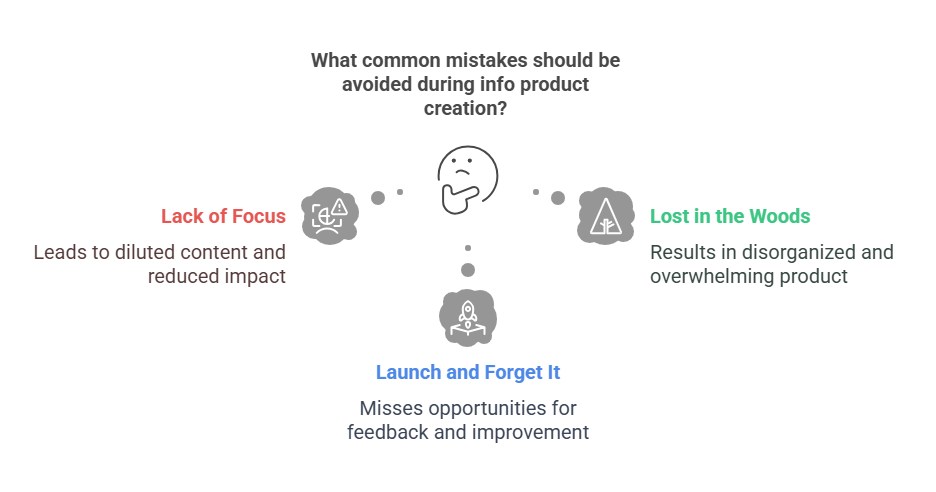
Mistake 1 – Lack of Focus
In Moby Dick, Herman Melville set out to tell the reader everything that was known about whaling and weave it into a grand story. With your information products, you are not going to do that.
Many businesses make the colossal mistake of trying to do it all in one information product. In trying to create the bible of their niche, they end up with a product that's unfocused and difficult to digest, if they ever finish it at all.
Solution: Take just one problem or question your audience has and solve it in the quickest, easiest way possible. This is called a minimum viable product (MVP). It is the smallest product possible that still offers true value for the buyer. It's tightly focused, and at the end, the customer has learned something they can use.
For example, you want to create a product on blog writing. The last chapter is on publishing. As you go about writing it, you realize that you have too much to cover. The solution is to create one product on writing and another on publishing.
Mistake 2 – Lost in the Woods
The devil is in the details. There are many ways to solve any particular problem. There's no way you could possibly cover everything, and even if you could, your reader might end up confused about which path to take.
Solution: Figure out one way to solve the problem that's faster, cheaper, and/or easier, and lay this out step by step for your audience. Tell them, "In this report, this is how we're going to do this one method for solving the problem."
For example, you're creating a product on organizing a daily to-do list. There are millions of ways to do this, so you choose one that you've used before and that works for you to teach your reader.
Mistake 3 – Launch and Forget It
Creating information products isn't rocket science, but your launch is kind of like a rocket launch. Once it shoots up in the air, that’s only the beginning of its journey.
You don't create a product, launch it, and then wait for the money to roll in. While you can achieve multiple forms of residual income that pay you while you sleep, there is still work to be done post-launch, and knowing how to turn a flop into success can make all the difference in keeping your momentum strong.
Solution: As part of your streamlined info product creation system, plan post-launch work that includes stellar customer service, following up with customers for feedback to inform future products, and keeping in touch with customers to nurture this precious relationship.
These pitfalls can all be avoided with a simple system for information product creation that produces high-quality products quickly.
What Kind of Information Products Can You Create?
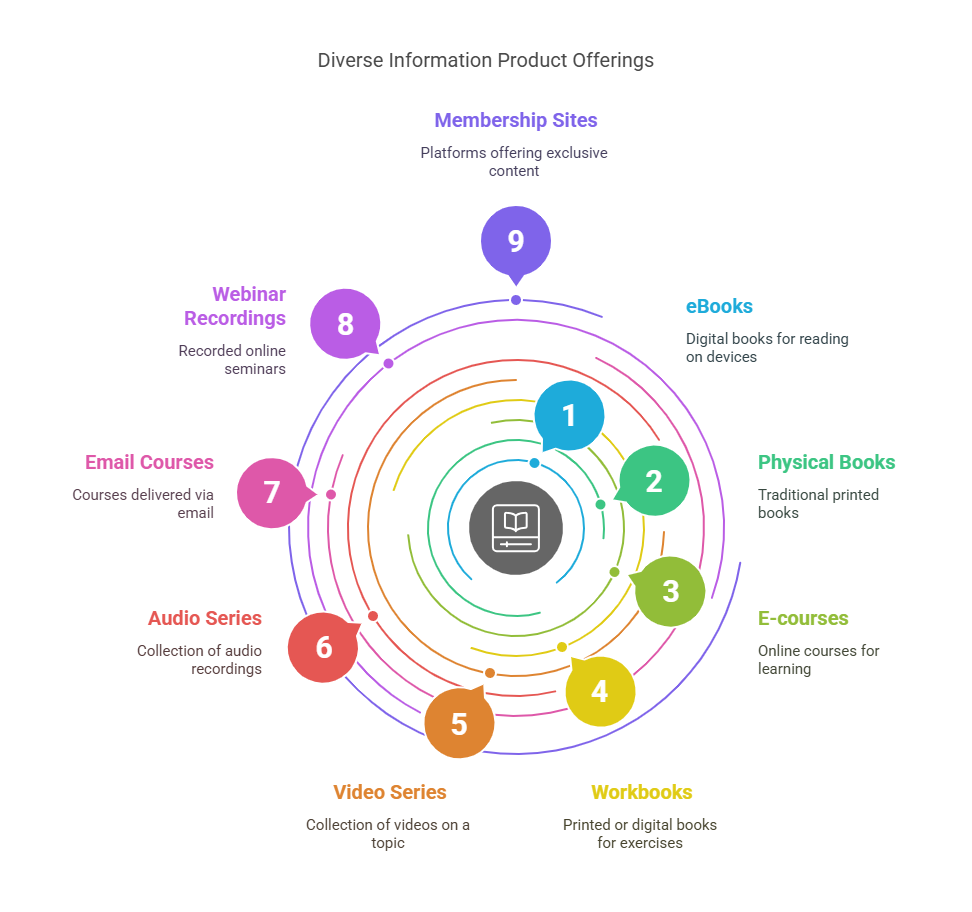
There's a huge market these days for information products. Digital information products are digital files that are distributed over the Internet. The advantage for you, the product creator, is that there is very little overhead and info product creation is easy. It's just a matter of identifying a specific problem and solving it for your audience, and using profitable growth hacks can help you scale and amplify the impact of your products even faster.
If you're just getting started with information products, here are some ideas of the type of products you can create:
eBooks
eBooks are "electronic books." In other words, they're PDF files that you can download and read on a PC or on an Amazon Kindle or other similar device. You create your book in Word format and then add a cover, table of contents, and other elements, and it's ready to go.
Physical Books
There are a number of self-publishing platforms online that allow you to create and publish actual books, such as Lulu or KDP. Some authors prefer to have a physical book to distribute offline. One strategy is to publish your book both electronically and physically.
E-courses
An e-course is some kind of educational course that's offered online. You can teach an actual live course through platforms or programs like Skype or GoToWebinar.
Workbooks
The format of workbooks is similar to an eBook or physical book, but the important difference is that the student does the actual work. In addition to presenting the information, there are activities for your customer to work through. They learn and implement as they go.
Video Series
Videos are very easy and cheap to produce today, and video offers an alternative format to text. Some people prefer learning through video, and it works better for certain types of tasks where people need to see what they're doing.
Audio Series
You can release an audio series by producing MP3s that your audience can listen to on the go using a smartphone or other device. Again, audio offers another way for people to learn.
Email Courses
An email course is a course that's delivered over email. You send out periodic messages using an email marketing program like Aweber or GetResponse. The format can be text, video, audio, or whatever else your audience prefers.
Webinar Recordings
If you host webinars, you can record them and use them as an information product. This is one way to leverage your content to get more mileage out of it.
Membership Sites
A membership site is where you offer various content, offers, or courses exclusively for members.
Which format is best depends on your capabilities and the tastes of your audience. Try to discover how they like to learn and create the content that matches their preferences.
Use a Fast Information Product Creation System
As a business owner, you have some type of expertise you can use to solve your audience's problems. The goal of your product is to identify this problem and offer one way to solve it that's quicker, cheaper, or easier than other solutions out there.
The best strategy is to produce a high volume of small products, each of which addresses a specific problem. Brainstorm a list of ideas for common problems you can solve, and you're ready to get started creating your first product.
Creating profitable information products is only half the battle. The real magic happens when you launch them the right way. Even the best products, courses, and services can fail if they’re poorly introduced to the market. That’s why we’re giving you free access to the Ultimate Launch Toolkit, your complete guide to building buzz, attracting buyers, and maximizing sales from day one.
Whether you’re launching a brand-new information product or looking to relaunch and reignite an existing offer, this toolkit has everything you need to get it right. It’s already helped over 100 creators, entrepreneurs, and business owners hit 5- and 6-figure months.
Now it’s your turn. Download the FREE Ultimate Launch Toolkit now and set your next launch up for massive success!
Frequently Asked question's
An info product is any digital product that shares knowledge or solves a problem. Examples include eBooks, online courses, webinars, templates, and coaching programs.
Selling information products means creating and offering digital content—like guides, courses, or training that delivers value, usually online, in exchange for payment.
In a library, information products often refer to resources like research papers, digital archives, databases, reports, and e-learning modules.
The four common types of products are convenience products, shopping products, specialty products, and unsought products. While the first type includes everyday items, the other types of products can be identified as compared for quality/price, unique, or high-end, and not actively sought-out products like insurance.
Products can be of various types. Some examples include online courses on marketing, a physical fitness tracker, a coaching program, mobile apps, and a subscription box service.
The seven most common stages of developing a product are idea generation, idea screening, concept development and testing, business analysis, product development, test marketing, and commercialization. The final stage concludes with the launch of the product.